

Tenant's Corner - May 2026
The Tenant’s Corner
What Your Lease Really Costs (It’s Not Just the Rent)
One of the biggest misconceptions I see when businesses begin searching for commercial space is the belief that the asking rent tells the full story.
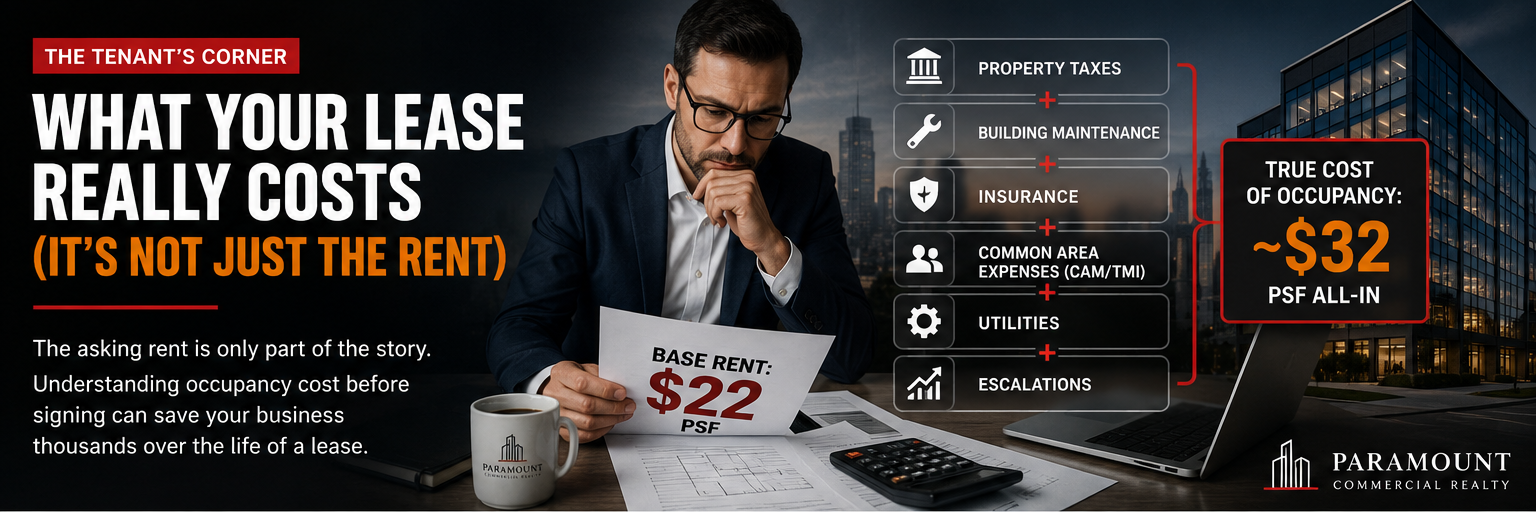
A tenant tours a property, sees a quoted rental rate of $22 per square foot, and immediately begins comparing it to another space at $18 per square foot. On the surface, the lower number feels like the obvious winner.
In reality, it rarely works that way.
The asking rent is usually only one component of your total occupancy cost, and focusing on that number alone can lead tenants to underestimate what they will actually spend over the life of the lease.
In most commercial leases, tenants are responsible for more than just base rent. Additional costs often include property taxes, building insurance, maintenance expenses, and common area costs—frequently referred to as CAM, TMI, or operating costs depending on the property type and lease structure. Once those items are added in, a space advertised at $22 per square foot may realistically function closer to $30 or even $32 per square foot on an all-in basis.
This is where many tenants unintentionally make poor comparisons.
I often see situations where one property appears less expensive because the base rent is lower, while another looks more expensive at first glance. But after reviewing the operating costs, escalation structures, and projected occupancy expenses over several years, the “cheaper” option can actually become the more expensive one.
That distinction matters because occupancy cost is not just a monthly expense—it directly affects profitability, cash flow, staffing flexibility, and long-term operational stability.
A lease should never be evaluated based solely on the first-year number.
It should be evaluated the same way you would assess any long-term business commitment: by looking at the total financial impact over the full term of the agreement.
Another area tenants frequently overlook is incentives.
Landlords may offer inducements such as free rent periods or tenant improvement allowances to make a deal more attractive. These incentives can provide meaningful value, particularly for growing businesses trying to preserve capital during a move or expansion. However, incentives can also create confusion if they are not analyzed properly.
A space offering several months of free rent may appear more attractive initially, but if the operating costs or future rent increases are aggressive, the long-term economics may still be unfavourable. Conversely, a property with fewer incentives but stronger long-term stability may ultimately represent the better business decision.
This is why I encourage tenants to stop asking only:
“What’s the rent?”
and start asking:
“What will this lease actually cost my business over the full term?”
That question changes the conversation completely.
It shifts the focus from marketing numbers to financial reality.
A proper lease analysis should account for all rent components, projected escalations, operating costs, insurance minimums, management fees, supervisory fees, administrative charges, concessions, inducements, measured rentable versus useable square feet, restoration costs, termination penalties, over-holding costs and the timing of expenses over the entire agreement. Even a straightforward side-by-side comparison over a three- to five-year period can reveal major differences that are not obvious during initial negotiations.
In my experience, the tenants who make the best real estate decisions are not necessarily the ones who negotiate the lowest headline rent. They are the ones who fully understand the structure behind the numbers and how those costs will impact their business over time.
Commercial leasing is not simply about securing space. It is a strategic financial decision that influences operations every month you occupy the property.
The clearer your understanding of your true occupancy cost, the stronger your position becomes when comparing opportunities, negotiating terms, and protecting your business from unexpected financial pressure down the road.
In next month’s Tenant’s Corner, we’ll look at how rent escalations work—and how to plan for them before they impact your bottom line.


Copyright 2023. All rights reserved
Copyright 2023. All rights reserved
Follow