


Market Snapshot - October 2026
Canada & Greater Toronto Area
Commercial Real Estate Market Report
Q3 2026 | September/October 2026 Edition
Prepared by: Paramount Real Estate Properties Inc.
Market Focus: Greater Toronto Area (GTA)
Asset Coverage: Residential, Multifamily Rental, Office, Industrial, Retail, Land
EXECUTIVE SUMMARY
Here we are in October already. Canada is entering Q4 2026 with a sputtering economy. GDP remains in slightly positive territory, no thanks to declining manufacturing numbers, while jobs are increasingly harder to find. At the same time, inflation and the cost of borrowing is still a worry for many Canadians. With that said, not every part of the real estate market is weak. Office leasing is improving. Industrial demand is picking up. Many local shopping plazas remain full. Affordable rental apartments are filling-up. The lesson is simple: the type of property and its location matter more than ever.
• Residential: GTA home prices are lower than a year ago, but buyers still worry about jobs and mortgage costs.
• Multifamily: GTA rental vacancy is 3.8%. New premium apartments face more competition than lower-priced units.
• Office: GTA vacancy is 9.4%. Demand is improving, especially for modern, well-located space.
• Industrial: Demand has absorbed more space than builders have delivered, but tenants still have options.
• Retail: Neighbourhood plazas remain tight, while some enclosed malls face empty large stores.
• Investment: Buyers are active, but the price, cash flow and cost of debt must make sense.
This market snapshot attempts to provide you with a sector-by-sector assessment of current conditions and the economic drivers behind recent changes, along with their implications, for tenants, buyers, landlords and investors. Each month, we point-out what has changed, why it matters, and what you should watch before making a real estate decision over the next six to twelve months.
1. Macroeconomic Overview
Business sentiment has weakened. It has less to do with the potential impacts of tariffs, and more to do with the real impacts of higher input costs, including elevated energy prices due to the war in the Middle East. Compared with the first quarter of 2026, more firms reported rising input costs and geopolitical uncertainty caused by wars are weighing on business conditions. Consistent with this, the share of firms planning or budgeting for a recession in Canada over the next 12 months rose from 9% to 17% (according to a recent Ipsos Reid poll). Even so, this share remains below the levels seen throughout 2025.
1.1 Labour Market Conditions
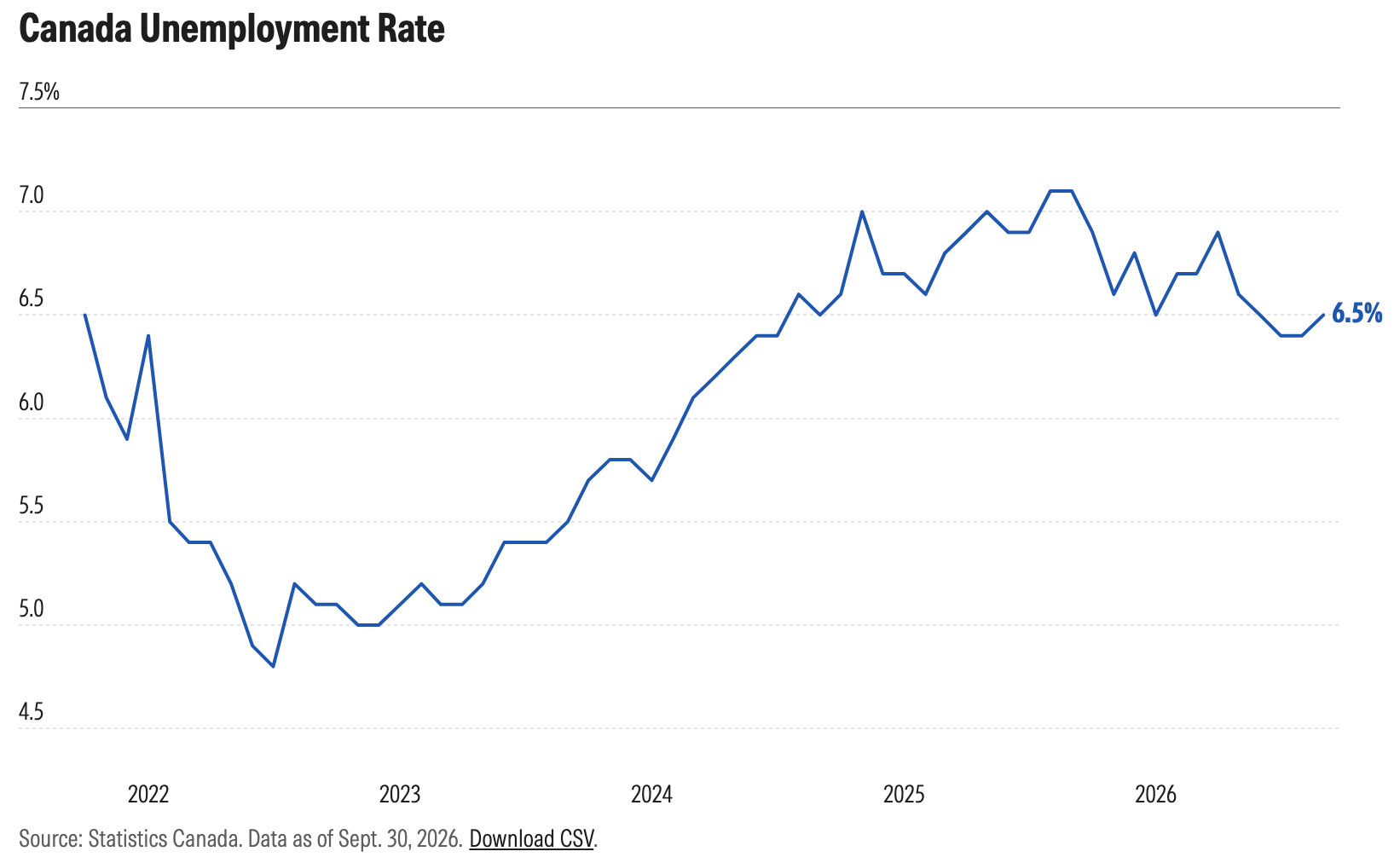
Canada’s unemployment rate reached 6.5% in September, up from 6.4% in August. That small move still matters. Canadians feel less secure about their jobs, so they’re less likely to buy a home or take on a new mortgage. Businesses may also delay taking-on new debt for re-investing, hiring or leasing more space.
Economic growth has been weak as well. Canada recorded modest growth in the second quarter, while July GDP was flat and an early estimate pointed to 0.2% growth in August. These are not signs of a strong rebound. They also do not prove a recession. What they tell us is that the economy has little room for another major shock from trade disputes or accelerating inflation.
For tenant occupiers of space and investors of real estate alike, the practical question is whether they feel confident enough to hire, expand and invest in Canada.
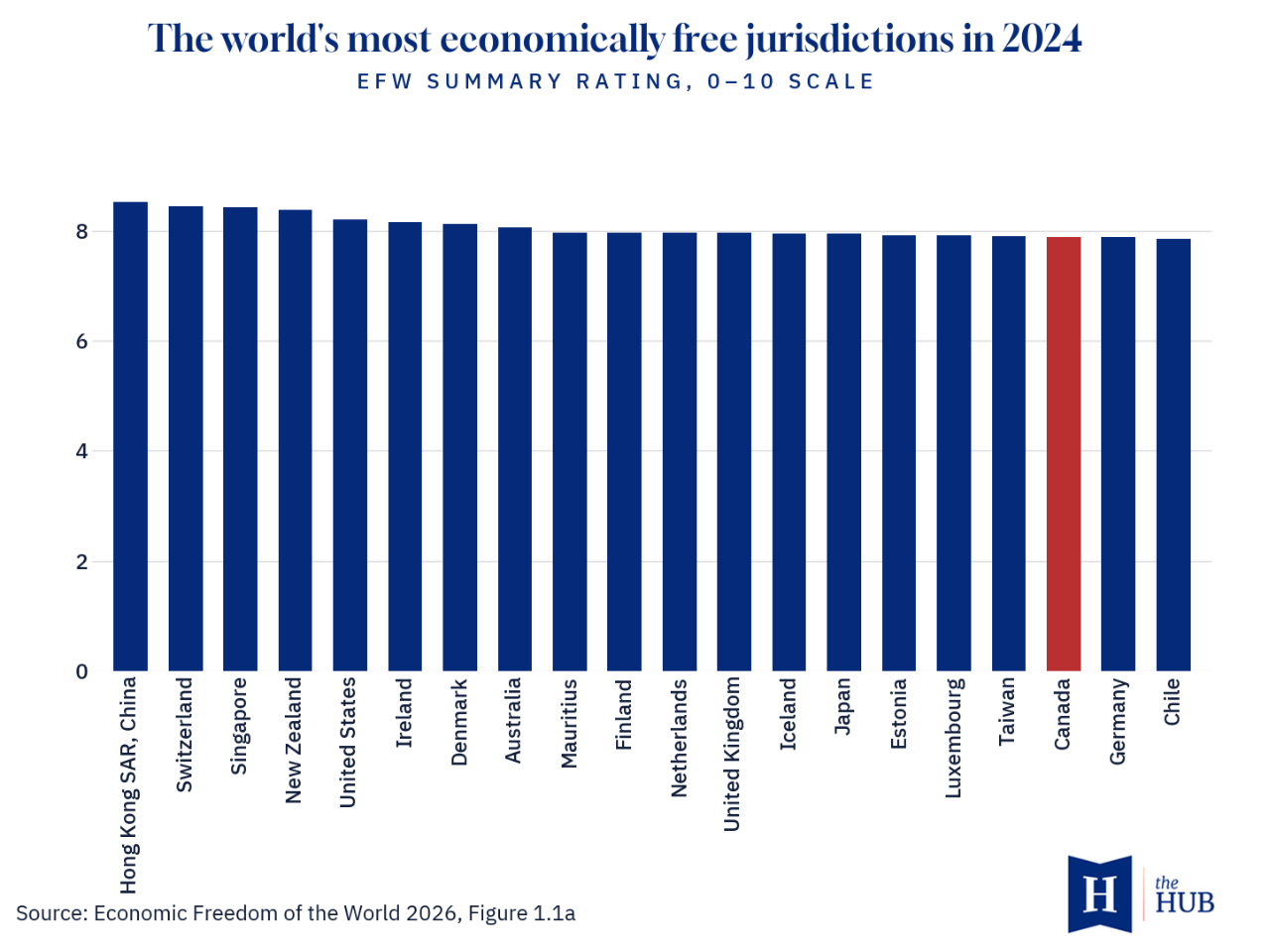
This month, the Fraser Institute ranked Canada 18th in its 2026 Economic Freedom Report. The report highlights that Canadians have had less economic freedom than individuals in 17 other countries since 2024 figures were recorded, with significant drops in areas such as international trade. The findings raise concerns about the impact on living standards and overall economic health in Canada going forward.
1.2 Population Trends
Canada’s population growth has slowed as fewer temporary residents arrive and more leave. Immigration has stalled and that worries builders of new construction. It takes between 6 -8 years, roughly, before arriving at a place where newcomers can afford a home. This change affects rental housing first because newcomers often rent before they buy. It can also slow demand for shops, services and some types of business space.
There is another side to this story. Canada’s population is getting older, which should support demand for healthcare and seniors housing over time. The changing makeup of our population isn’t one simple trend. It creates both risks and opportunities, depending on the property and the people it serves.

According to a report written this month by the Bank of Canada entitled “Demographic changes are reshaping the Canadian economy”, an older population and fewer immigrants are changing the economy by shrinking the workforce, shifting what people consume, and how much the economy can produce.
In the coming years, if fewer immigrants are expected to arrive, demand for housing will be reduced. This could lower pressure on housing costs. At the same time, less immigration will mean fewer workers and weaker demand for other goods and services. The economy won’t grow as fast as a result. Labour shortages could push up wages in some sectors, which could affect prices and contribute to inflation.
An aging population will change the goods and services we produce because older people have specific needs.
• Older people have different housing needs, and many choose to move to smaller homes that are easier to maintain.
• Some retirees travel more and spend more of their income on leisure, which could affect the cost of travel services such as flights and accommodation.
• Older people spend more of their money on health care. This adds to demand for pharmaceuticals, adaptive living products and supportive home care services. Given Canada’s system of universal health care, it could also change how much governments need to spend on hospitals and long-term care—as well as the level of taxation needed to fund these services.
1.3 Inflation and Monetary Policy
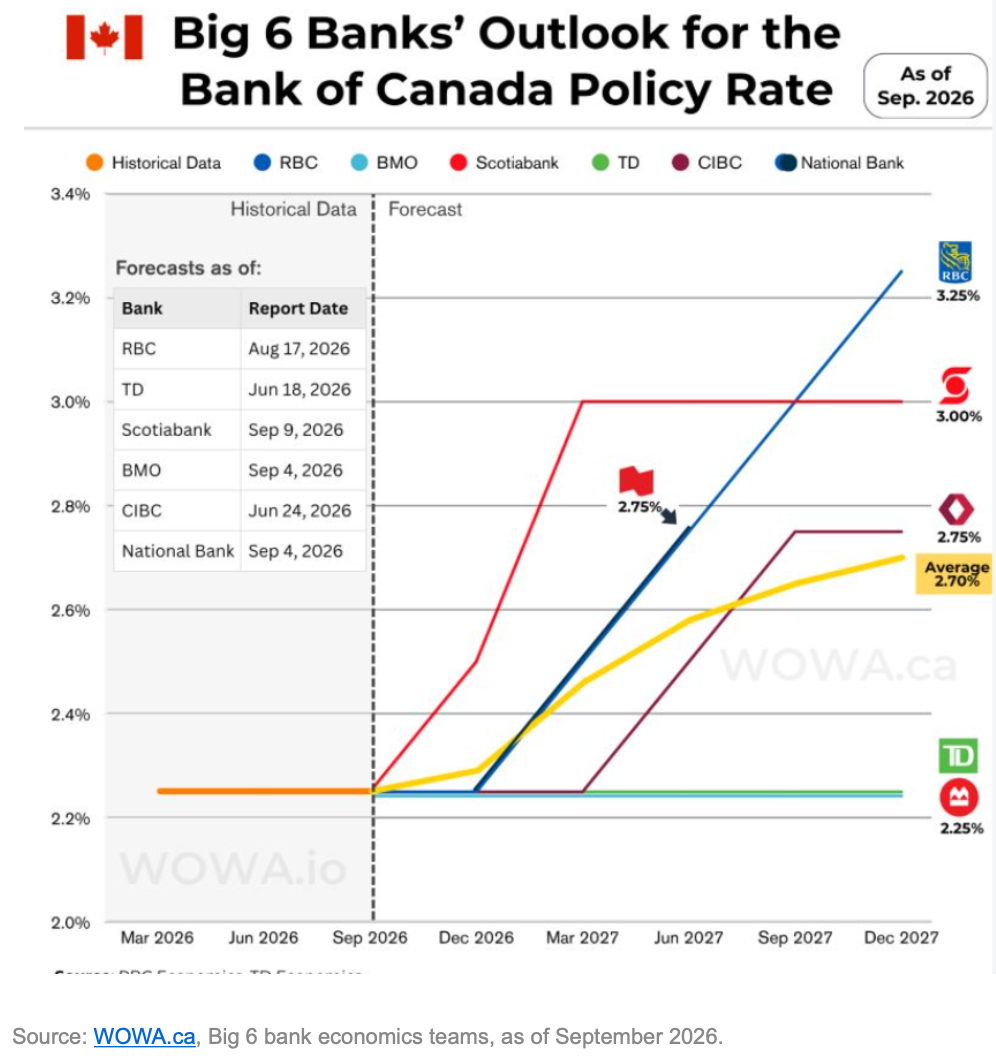
The Bank of Canada’s overnight rate remains at 2.25%, while the five-year Government of Canada bond yield has been moving around 3.60%. These rates do different jobs. The Bank’s policy rate has a stronger effect on variable borrowing costs. Bond yields help shape many fixed mortgage and commercial loan rates.
Higher U.S. bond yields can also push Canadian financing costs up, even when our economy is weak. So I would not assume that a steady Bank of Canada rate means your next mortgage quote will stay the same. Over the coming months, watch both inflation and bond yields, and ask lenders to test payments at more than one rate.
2. GTA Asset Class Analysis
2.1 Residential Housing Market
Greater Toronto Area (GTA) home sales remain slow despite many buyers waiting on the sidelines. The average selling price in September was about $1,006,409, down 5.1% from a year earlier. Lower prices help, but they do not remove the fear of job loss or the challenge of qualifying for a mortgage.
The condo resale market is especially sensitive to high monthly carrying costs and competing listings. For buyers, the focus will be on the full monthly cost of ownership, not just the sale price. For developers, weak presales make it harder to secure financing and start new projects.
Some buyers may act sooner if they fear mortgage rates will rise. But that could bring future sales into the present rather than signal a lasting recovery. Over the next six to twelve months, job confidence and borrowing costs will be just as important as home prices.
As it stands in Q4 2026, the current gap between what most GTA residents can afford to pay, in monthly mortgage costs, versus what they need to pay for their ideal home is roughly $589 per month; so for many, renting remains the viable option.
2.2 Multifamily Rental Market
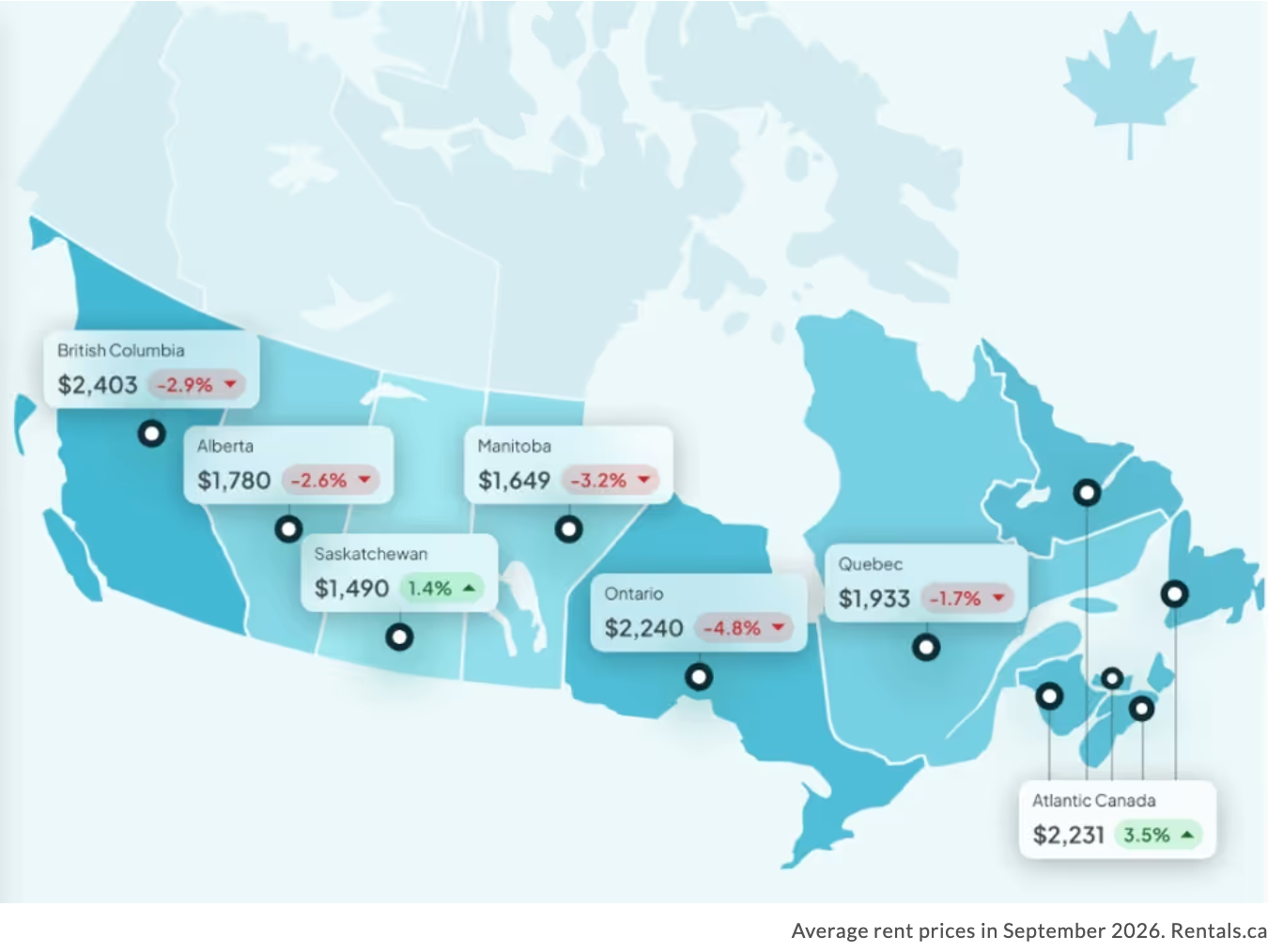
Canada has experienced 24 consecutive months of year-over-year declines in average residential asking rents, marking two full years of downward trends through September 2026.
The GTA rental market is moving from a severe shortage toward more affordable choices for tenants. Vacancy has reached around 3.8%. Over the past year, about 8,303 units were completed and 7,899 were taken up. Average asking rent was $2,223 a month, down 1.5% from a year earlier. After discounts and incentives, effective rent was about $2,096, down 3.1%.
The biggest pressure is at the higher end of the market. Premium apartments had 11.8% vacancy, compared with 2.5% in lower-priced buildings. Of roughly 26,002 rental units under construction, about 19,262 are premium units. This means more new buildings may soon be competing for the same group of renters.
For renters, that can mean better choice and more room to negotiate. For owners and investors, expect slower lease-up times, some free-rent offers and more turnover. For underwriting, use the rent you can actually collect, not the rent you hope to advertise. GTA multifamily sales of about $3.2 billion over the past year show that investors still see value, but every building needs its own review.
2.3 Office Market
Office leasing has shown one of the clearest improvements since 2025. GTA vacancy is 9.4%, and occupied space grew by about 6.8 million square feet over the past year. More firms are bringing staff back to the office, and many want modern buildings near transit and services. In many cases, a full staff return isn’t feasible since companies have spent the last five years downsizing and consolidating offices. Their footprint and office configuration doesn’t have the capacity for bringing back a full workforce. However, these last five years have also seen many companies opting for shorter term leases, and so there could be an expansion rebound on lease renewals when strong economic times return.
Still, the biggest impediment to a full-time return to the office is commuting. Costs in time, money and convenience outweighs the incentive to commute 5 days a week. Those offices located near public transit hubs, along nodes or connected directly to a station are the most sought-after buildings. Vacancy had dropped to 9.0% in the Financial Core, but the recovery is far from equal.
Vacancy remains high in Mississauga City Centre (at 19%), 13.3% around the Airport and 8.0% in Oakville/Burlington. A tenant looking in Mississauga may have much more choice than one seeking trophy space in downtown Toronto.
Active tenants would be wise to compare the whole lease deal: rent, operating costs, free rent, improvement money and flexibility. A lower quoted rent is not always the lowest total cost. For investors, a vacant office building can look cheap until you add the cost of upgrades, leasing fees and the months without rent. Strong leasing news does not remove those risks.
2.4 Industrial Market
Industrial demand is getting stronger. GTA businesses occupied about 10.9 million more square feet over the past year, while builders delivered 8.0 million square feet. Vacancy is now 4.0%, but availability is higher at 6.5%. Availability includes space being marketed for future use, so it gives tenants a broader view of their options.
Average asking rent is about $18.75 per square foot, nearly unchanged from last year. Conditions vary: vacancy is 5.4% in North GTA West and 5.2% in Brampton, compared with 3.6% in Mississauga and 3.5% in Oakville/Burlington. Another 16.5 million square feet is under construction, with just over half already leased.
For tenants, this is still a good time to test the market before renewing. Compare shipping access, clear height, power, extra rent and landlord incentives, not just the base rent. For buyers, I would be careful about assuming the fast rent growth of the pandemic years will return. A building must work at today’s rents and financing costs.
2.5 Retail Market
GTA retail space remains tight overall. Availability is below 3%, asking rents are up 1.9% from last year, and average market asking rent is around $37.09 per square foot. Very little new space is being built, which helps keep well-located stores in demand.
The type of retail property makes a big difference. Neighbourhood centres show 1.4% vacancy and strip plazas only 0.7%. Enclosed malls are much softer at 9.6%, partly because large department stores have closed. Grocery, pharmacy, health, fitness and everyday services continue to help fill neighbourhood locations.
For retail tenants, a vacant large store in a mall does not mean the right small storefront is easy to find. For investors, a busy grocery plaza and an empty department store are two very different opportunities. The first may offer steady income; the second may need major spending and years of planning before it pays off.
3. Commercial Real Estate Investor Perspective
Investors are still buying, total activity is up over last year, but they are taking a closer look at risk. Over the past twelve months, the GTA recorded about $5.6 billion in industrial sales, $3.2 billion in multifamily, $2.6 billion in office and $1.8 billion in retail. These are rolling annual totals, not sales completed in the fourth quarter.
The biggest rebounds in Toronto thus far: Multifamily and Office properties; up over last year’s transaction volume by 244% and 125% respectively. Sustained demand continues from buyers of Retail and Industrial properties, up by 30% and 38% respectively. While, investment for hotels has dropped-off by double digits.
The range of deals is telling. Some buyers want stable income from strong tenants. Others are willing to buy partly empty buildings if the price leaves room for repairs, leasing costs and a longer wait for returns. Owner-users are also buying industrial properties to control their future space needs.
Before buying, three questions should be addressed: What income can this property earn today? What will it cost to keep or attract tenants? And can the property carry its debt if rates stay high or rent growth slows? A discount from an old asking price is not enough. The price must make sense beside the real risks.
Before developing, the big questions that need answering: Has a project’s proforma incorporated all the risks of inflation from inputs such as rising material costs, borrowing costs, operational costs (including labour) and cost of investment capital.
4. Going Forward – 2026
As we head toward 2027, expect the market to remain uneven. Office and industrial leasing are improving, but weak household budgets, slower population growth, trade risks and high bond yields could slow the next stage of recovery. Retail should continue to favour strong local services. New premium rental apartments may need more time and incentives to fill.
If you’re a business planning a lease renewal, start early and create competition between suitable properties. Remember, you’re likely required to give your landlord notice 9 – 12 months in advance of your intention to renew or relocate. So, if you’re expiry is anticipated within the next 18 months, front-run any surprise from the market and explore your options now as concessions and incentives are starting to fade as vacancy rates decline.
If you’re buying or refinancing, stress-test your numbers with higher interest rates, slower leasing and extra repair costs. If you own property, focus on keeping good tenants and knowing what it will cost to replace them. If you’re seeking to acquire property this year or next, give yourself a 6-month window to find, secure, perform due diligence, finance and close. We can help you shorten those timelines and save you money.
The best decisions come from understanding both the market and the property in front of you. Its more prudent to see a deal work under cautious assumptions than depend on a quick drop in interest rates or a jump in values.
Paramount represents tenants, buyers and investors only, without landlord or seller representation conflicts. My goal is to protect your downside, improve your negotiating position and help you secure the right property at the right price.
Book a complimentary 15-minute strategy call and get clarity before you make your next move.
Go on, entrepreneur — be great.
Mel
Disclaimer
This disclaimer shall apply to Paramount Real Estate Properties Inc., Brokerage, and to all other divisions of the Corporation; to include all employees and independent contractors (“PARAMOUNT”). The views and opinions expressed in the articles/posts/newsletters written or provided herein are solely those of the author and do not necessarily reflect the view of any entity or person other than themselves. This blog post provides general information and discussions about the local, provincial and national commercial real estate market. The information and other content provided in this blog post, or in any linked materials, are not intended and should not be construed as financial or investment advice. The views expressed in this blog post are those of the author and do not necessarily represent the views of any other person, company, or organization. The information contained in these articles/posts/newsletters are subject to change without notice. The author does not guarantee the accuracy or completeness of any information in this blog post and is not responsible for any errors or omissions or for the results obtained from the use of such information. The author assumes no liability or responsibility for any damage to you, or other property, due to your access to, use of, or downloading of this blog post or any materials provided within.


Copyright 2023. All rights reserved
Copyright 2023. All rights reserved
Follow