
Tenant's Corner - June 2026
The Tenant's Corner
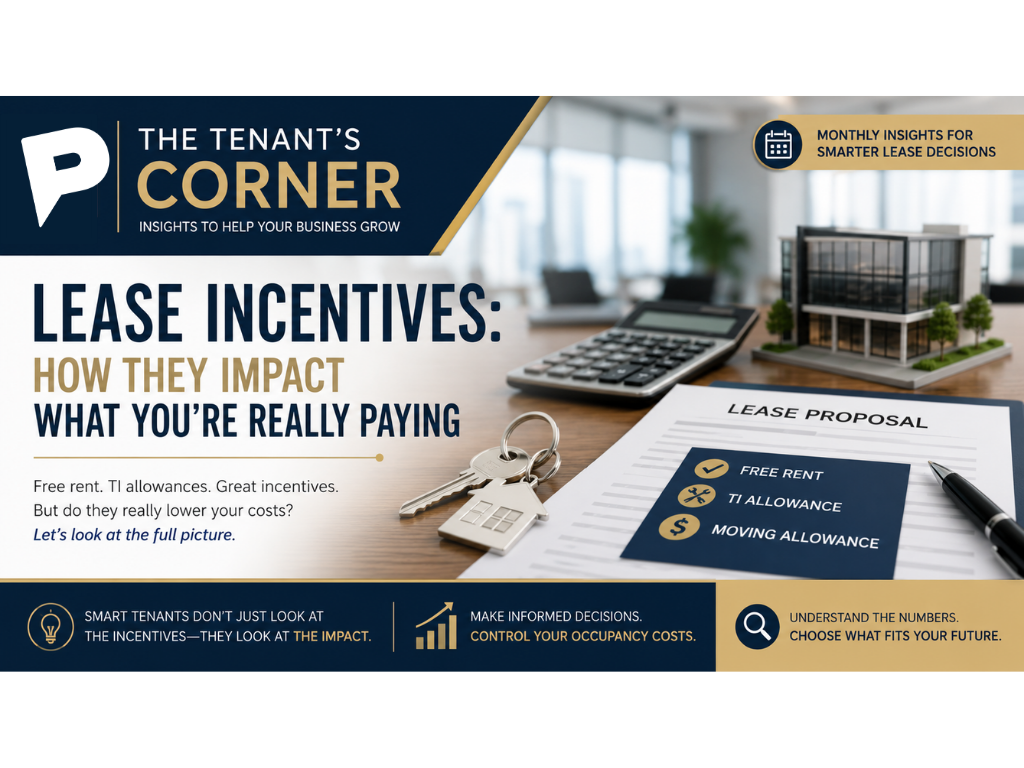
Lease Incentives: Looking Beyond the Rent
One of the most interesting trends I see when tenants compare lease opportunities is how quickly attention shifts to the rental rate.
A lower rental rate often feels like the better deal.
After all, if one landlord is quoting $20 per square foot and another is quoting $24 per square foot, the decision appears straightforward.
But commercial real estate is rarely that simple.
In fact, some of the most attractive lease transactions I've negotiated were structured in ways that initially appeared more expensive, yet ultimately delivered greater value to the tenant over the life of the lease.
That's because the quoted rental rate is only one piece of the transaction. Lease incentives can dramatically change the economics of a deal—and understanding how they work can help tenants uncover opportunities that might otherwise be overlooked.
Why Landlords Offer Incentives
Commercial landlords compete aggressively for quality tenants.
One of the ways they do this is through incentives such as free rent periods, tenant improvement allowances, moving allowances, fixturing periods, and other inducements designed to make occupancy easier and more affordable.
For tenants, these incentives can create meaningful value.
A tenant improvement allowance may reduce or eliminate the capital required to renovate a new space. Free rent can help offset moving expenses, employee disruption, technology upgrades, or other transition costs associated with relocation.
These incentives are not simply marketing tools. They are often legitimate financial benefits that can improve a tenant's overall business case.
The key is understanding how to evaluate them properly.
Why the Face Rate Doesn't Tell the Whole Story
Many tenants make the mistake of comparing lease opportunities based solely on the quoted rental rate.
However, landlords and tenants often structure transactions differently depending on the objectives of both parties.
A landlord may be willing to offer a stronger incentive package while maintaining a higher face rental rate. Another landlord may offer fewer incentives but quote a lower rent.
Neither approach is inherently better.
The question is not which proposal has the lowest rental rate.
The question is which proposal creates the greatest overall value.
This distinction is important because a higher face rate combined with meaningful incentives can sometimes produce a lower effective occupancy cost than a lease with a lower quoted rent and fewer inducements.
In other words, what initially appears more expensive can actually become the better financial outcome.
The Win-Win Behind Incentives
One aspect of lease incentives that many tenants overlook is that they often create benefits for both sides of the transaction.
The tenant receives financial assistance that reduces upfront costs and improves cash flow.
The landlord maintains stronger face rental rates, which can support the property's income profile, financing metrics, and long-term asset value.
This alignment of interests is one reason incentives are so common in commercial real estate.
Contrary to what some tenants believe, incentives are not necessarily a sign that something is wrong with the property.
More often, they are simply a tool that helps bridge the gap between landlord objectives and tenant objectives.
When structured correctly, both parties can achieve a favourable outcome.
Understanding Effective Rent
This is where the concept of effective rent becomes valuable.
Rather than focusing exclusively on the rental rate, effective rent considers the complete economics of the transaction, including incentives.
It helps tenants understand what they are truly paying after free rent periods, improvement allowances, and other inducements are factored into the equation.
More importantly, it allows multiple lease proposals to be compared on an apples-to-apples basis.
Sometimes the lease with the lowest quoted rent remains the best option.
Sometimes it doesn't.
The only way to know is to evaluate the entire transaction.
Looking at the Bigger Picture
Imagine two competing lease proposals.
One offers a lower rental rate but minimal incentives.
The other offers a higher rental rate accompanied by significant free rent and a substantial tenant improvement allowance.
At first glance, many tenants gravitate toward the lower rent.
Yet once the incentives are quantified and the economics are analyzed across the full lease term, the higher-rate proposal may actually deliver greater value.
This is why experienced occupiers focus on total occupancy cost rather than headline rental rates.
They understand that successful lease negotiations are not about winning a single point. They are about optimizing the entire transaction.
Final Thought
Lease incentives are not something tenants should automatically distrust.
Nor should they be viewed as a simple bonus.
They are a strategic component of lease negotiations that can significantly influence the economics of a transaction.
The most successful tenants understand that the best lease is not always the one with the lowest quoted rent.
Often, it is the one that creates the greatest overall value when all of the financial components are considered together.
Sometimes the opportunities that look most expensive at first glance turn out to be the most attractive once the complete picture comes into focus.
Next Month
We'll build on this concept by exploring a practical framework for comparing multiple lease opportunities side-by-side, helping tenants evaluate competing spaces on a true apples-to-apples basis.
Paramount Perspective: Don't judge a lease by its face rent; judge it by its effective economics.
If you're evaluating multiple lease proposals, don't stop at the rental rate.
The most important question isn't what the space costs today—it's what the transaction is worth over the life of the lease.
A careful review of incentives, occupancy costs, and effective rent can often reveal value that isn't immediately obvious from the headline numbers.
If you're currently comparing lease opportunities and aren't sure whether the incentives being offered actually represent good value, I'm always happy to help break down the numbers and evaluate the true cost of each option. Sometimes the differences aren't obvious until you see the entire picture clearly.
Let’s ensure your lease supports your operations, protects your flexibility, and keeps you from overpaying.
Book a complimentary 15-minute strategy call and get clarity before you make your next move.
Go on Entrepreneur — Be Great!!
Mel


Copyright 2023. All rights reserved
Copyright 2023. All rights reserved
Follow