

Investor's Corner - June 2026
The Investor's Corner
Cap Rates Made Simple: What Should Be The Proper Returns Commensurate To The Risk?
One of the most common questions I hear from investors is:
"Is this a good cap rate?"
It's a logical question. Cap rates are one of the most widely discussed metrics in commercial real estate and are often used as a quick way to compare investment opportunities.
Before we answer that question, however, it's worth understanding what a cap rate actually measures.
At its simplest, the formula is:
Cap Rate = Net Operating Income (NOI) ÷ Property Value
This tells us how much income a property generates relative to the price an investor pays for it.
The higher the price relative to the income, the lower the cap rate. The lower the price relative to the income, the higher the cap rate.
Simple enough.
But here's where many investors get tripped up.
A cap rate doesn't tell you whether an investment is good or bad. It simply tells you how the market is currently pricing a property's income stream.
The investors who consistently make the best decisions understand this distinction. Instead of asking whether a cap rate is good, they ask a different question:
"Is this cap rate sufficient for the risk I'm taking compared to my other investment options?"
That subtle shift in thinking can completely change how you evaluate an acquisition.
Looking Backward vs. Looking Forward
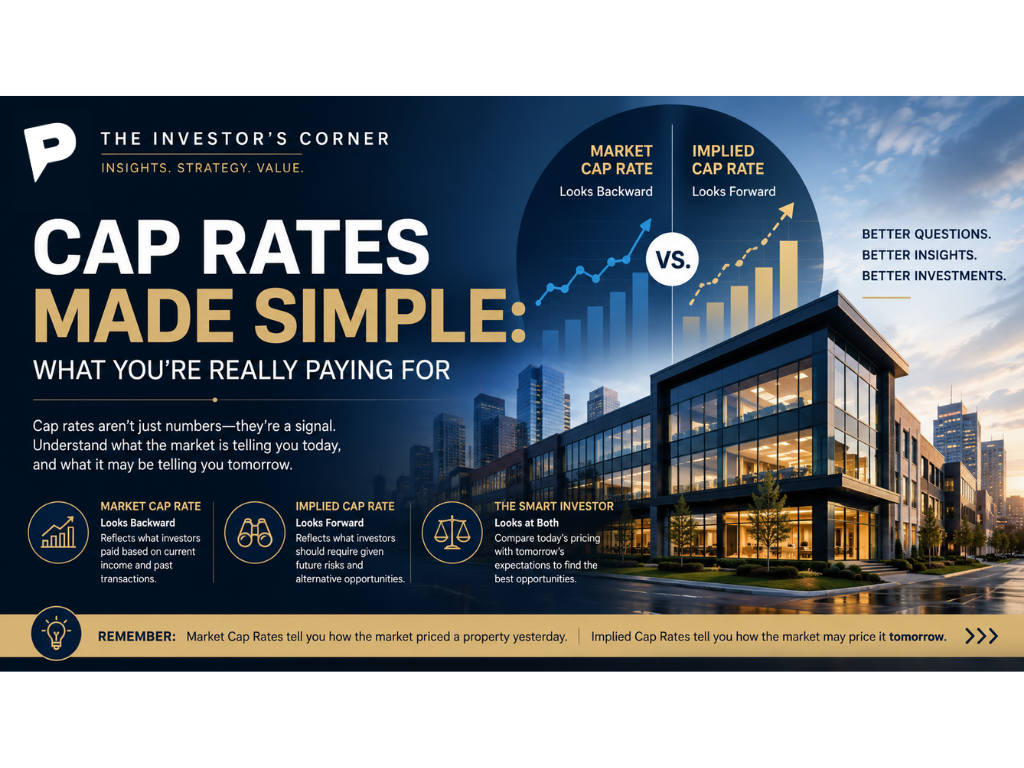
Most investors are familiar with what we might call the Market Cap Rate.
This is the cap rate reflected by recent transactions and current property performance. It tells us how investors are pricing a property's income today.
That information is useful because it provides a snapshot of current market sentiment and valuation.
However, Market Cap Rates have an important limitation.
They are largely backward-looking.
In most cases, market cap rates are derived from comparable transactions that have already occurred. Appraisers, brokers, lenders, and investors analyze completed sales to determine how similar properties have been priced by the market.
The challenge is that commercial real estate transactions don't happen overnight.
A transaction reported today may have been negotiated several months ago. In many cases, a deal may have been negotiated a year earlier, then spent months progressing through due diligence, financing approvals, legal review, and closing before finally becoming part of the transaction data available to the market.
As a result, the "current" comparable sale may not actually reflect current market conditions at all.
This issue becomes particularly noticeable during periods of market uncertainty or when transaction volumes decline.
In active markets with frequent sales, comparable data tends to remain relatively fresh. But in slower markets, investors may find themselves relying on reported transaction data that is six months old, while the pricing that established those transactions may have been negotiated twelve months or more in the past.
During stable economic periods this may not be a significant concern.
However, when interest rates, inflation expectations, capital availability, or investor sentiment are changing rapidly, yesterday's transactions can quickly become poor indicators of today's pricing environment.
This is one reason why experienced investors don't rely exclusively on transaction comparables when evaluating value.
Market Cap Rates tell us where the market has been.
But investors don't earn returns in the past.
They earn returns in the future.
That's where the conversation becomes much more interesting.
Understanding the Implied Cap Rate
Experienced investors don't simply accept the market's cap rate at face value.
They often ask:
"What cap rate should I require before investing my capital?"
This is where the concept of an Implied Cap Rate becomes valuable.
Unlike a Market Cap Rate, which reflects how assets are currently being priced, an Implied Cap Rate attempts to estimate the return an investor should require given today's economic environment and the alternatives available elsewhere in the marketplace.
A simplified way to think about it is:
Implied Cap Rate ≈ Risk-Free Rate + Real Estate Risk Premium − Expected NOI Growth
While this isn't a precise formula, it provides a useful framework for thinking about value.
The Risk-Free Rate is often represented by Government of Canada bond yields. These yields establish a baseline return that investors can earn with very little risk.
The Real Estate Risk Premium represents the additional return investors require above government bonds to compensate for the risks associated with owning commercial real estate.
Many investors look to corporate bond spreads as a starting point when assessing risk premiums. For example, BBB-rated corporate bonds typically trade at a yield premium above government bonds because investors require additional compensation for credit risk.
Commercial real estate introduces many of those same risks, along with others such as vacancy, tenant rollover, capital expenditures, illiquidity, market uncertainty, and active management responsibilities. As a result, the required real estate risk premium is often greater than a simple corporate bond spread and can vary significantly depending on the asset class, location, tenant quality, and lease profile.
The final component is Expected NOI Growth.
Many investors assume future income growth is tied solely to inflation, but the reality is more nuanced.
Inflation certainly plays a role. Lease escalations, CPI-linked rent adjustments, and expense recoveries help preserve purchasing power and support income growth over time.
However, investors also consider growth that may occur beyond inflation. Rising market rents, population growth, supply constraints, redevelopment opportunities, operational improvements, and better asset management can all contribute to future NOI growth.
This distinction is important because investors are not simply purchasing today's income stream.
They are purchasing the future growth potential of that income stream as well.
The stronger the expected growth in NOI, the more comfortable investors may be accepting a lower current cap rate.
Why Opportunity Cost Matters
One of the most important lessons investors learn is that real estate doesn't compete only with other real estate.
It competes for capital.
Every dollar invested in a commercial property is a dollar that cannot be invested somewhere else.
That same capital could be allocated to:
Government bonds
Corporate bonds
Dividend-paying equities
Private credit
Precious metals
Cash and money market instruments
Alternative investments
As investors, we're constantly making allocation decisions.
The question isn't simply:
"Should I buy this property?"
The real question is:
"Should I buy this property instead of doing something else with my capital?"
That's where opportunity cost enters the conversation.
This relationship helps explain why premium apartment buildings, industrial facilities, and other growth-oriented assets often trade at lower cap rates than investors initially expect.
Buyers are not necessarily accepting lower returns.
They're incorporating future NOI growth into their investment decisions and pricing assets accordingly.
Why Property Values Move Even When Properties Don't
Consider a simple example.
If Government of Canada bonds are yielding 2%, many investors may gladly acquire a high-quality commercial property at a 5% cap rate. The additional return may appear attractive relative to the alternatives.
But what happens if bond yields rise to 5%?
Suddenly investors begin asking:
"Why should I accept a 5% return from a building when I can earn something similar elsewhere with significantly less risk and management responsibility?"
Nothing about the property may have changed.
The tenants may still be paying rent.
Occupancy may still be strong.
The building may still be well maintained.
The income may still be stable.
Yet the property's value can decline because investor expectations have changed.
We witnessed this exact phenomenon during the recent interest rate cycle. As interest rates and bond yields increased, investors demanded higher returns from commercial real estate. Cap rates expanded across many asset classes and property values adjusted accordingly.
The buildings themselves didn't necessarily become worse investments.
The cost of capital simply changed.
This is why successful investors pay attention to two separate markets.
The first is the property market, where rents, occupancy, tenants, and operating performance determine income.
The second is the capital market, where interest rates, bond yields, and investor expectations determine how that income is priced.
Understanding both is critical.
Final Thought
Cap rates are important, but they should never be viewed in isolation.
The Market Cap Rate tells you how investors are pricing income today.
The Implied Cap Rate helps you determine whether that pricing adequately compensates you for the risks you're taking and the opportunities you're giving up elsewhere.
Understanding the difference allows investors to move beyond simply comparing properties and begin thinking strategically about capital allocation.
Because ultimately, successful investing isn't just about buying real estate.
It's about allocating capital where it has the greatest probability of producing attractive risk-adjusted returns.
The most successful investors don't simply ask:
"What's the cap rate?"
They ask:
"Is this return sufficient relative to every other place I could invest my money?"
In my experience, that single question often separates average investment decisions from exceptional ones.
If you're evaluating an acquisition and want help understanding both the property's income and how it fits within today's broader investment landscape, I'm always happy to walk through the numbers with you.
Next Month
We'll explore value-add investing and discuss how experienced investors create additional wealth after acquisition by increasing NOI, improving operations, repositioning assets, and unlocking value that the market may have overlooked.
Paramount represents tenants, buyers, and investors only (no conflicts of interest). The goal is simple: protect your downside, strengthen your position, and help you secure the right property at the right basis. Reach out when you’re ready.
Go on, entrepreneur — be great.
Mel


Copyright 2023. All rights reserved
Copyright 2023. All rights reserved
Follow